
Tracing an Iowa Street Address
A street search works best as a sequence of checks, not as a single roster of people. Start with the address exactly as written, including its direction, unit, and any older spelling. In Iowa, the parcel's city or county jurisdiction determines which assessor page and map are relevant. The records that follow can identify an owner or a party to an instrument; they do not establish the current occupants of a home.
- Route the property. Use the Iowa assessor jurisdiction map to identify the city or county assessor responsible for the parcel. Search only the local portal that serves that area.
- Match the map. Compare the street address with the local parcel or GIS view. Keep the parcel identifier and map date; an approximate line is not a survey.
- Read the owner field carefully. The assessor's listed owner and mailing address concern a property account. They are not a list of people who live at that situs address.
- Follow recorded transfers. Search Iowa Land Records by county, party role, name, and recorded-date range. Check both grantor and grantee names, then inspect an available document image or ask the recorder about local records.
- Check voter data within its limits. A person can use the Secretary of State lookup for their own registration; it is not a reverse-address list of residents.
- Add a dated household clue. A historical street guide or criss-cross directory can connect an address to a printed entry in a particular year. Record its volume and page, then verify the clue independently.
At each step, write down the source, the date searched, and what the result actually says. If the owner name changes between the assessor and a deed, the difference may reflect timing, a trust or business name, or a different record date. Do not turn that gap into a claim about a resident. For a one-person search, use the resident lookup guide and its identity checks.
Iowa Assessor Routes by City
Iowa does not have one assessor screen with the same controls for every parcel. Assessment is handled through local city and county jurisdictions, so the right first move is to identify the jurisdiction before entering a name or address. The Iowa State Association of Assessors map and directory is the statewide route to those local offices. It helps answer where to search; it does not combine every local property card into one uniform database.
Use the map or list to select the city or county that covers the address, then confirm that the selected office's site serves that municipality. A postal city can differ from the local government that assesses the parcel. If a property sits near a city edge, confirm jurisdiction with the assessor or auditor instead of choosing an office from the mailing label alone.
The Iowa assessor jurisdiction map shown below is a routing page, not a statewide property record. After identifying the jurisdiction, follow its official link and note the local site's coverage and update information.
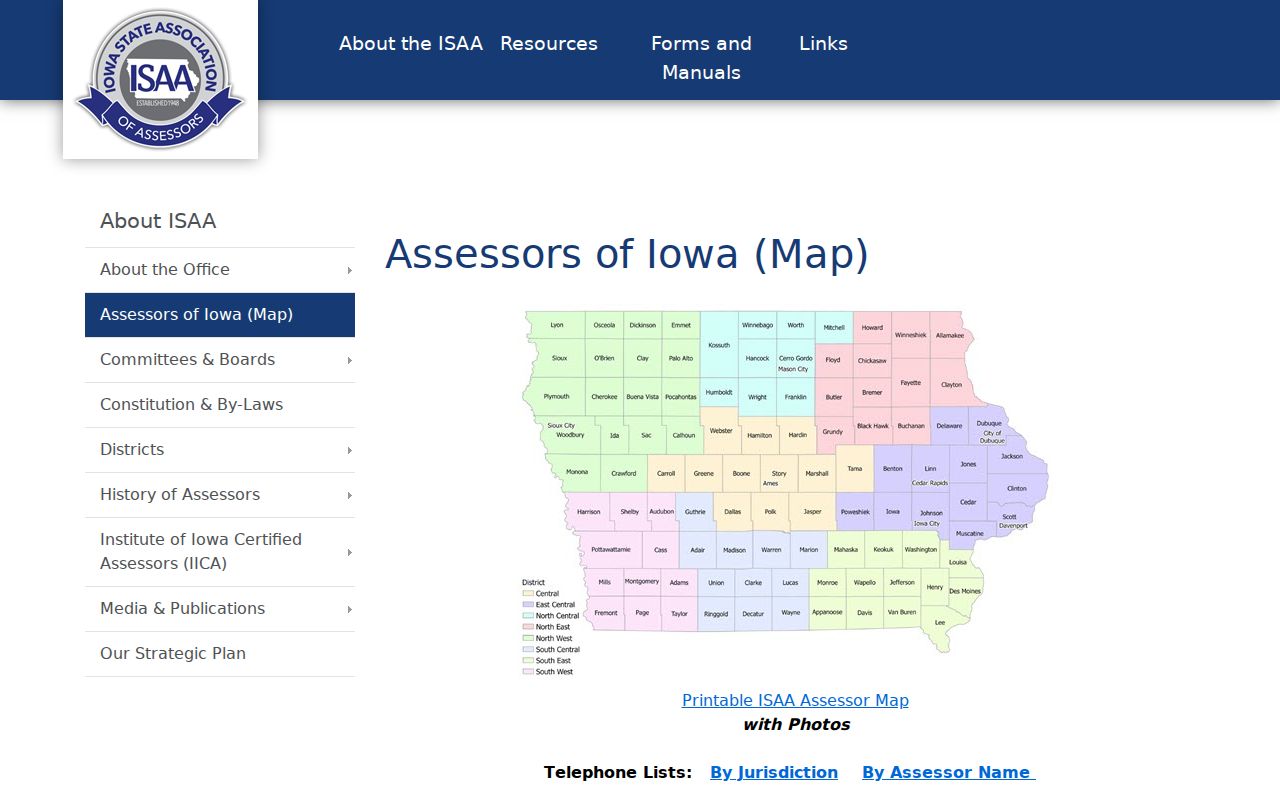
Keep the map separate from the record you retrieve. A routing list helps choose the custodian, while the local assessor page supplies the actual parcel data and any local disclaimer.
Iowa Address Record Search Fields
Local assessor sites vary in layout and required inputs. Across the research examples, common property fields include an owner or name search, situs address, parcel or PIN, property class, valuation, sales history, and, where offered, a sketch or photo. The labels below describe field types to look for, not a form every Iowa office must provide. The local portal's own instructions decide which entries are required.
| Field group | Common use | What to verify locally |
|---|---|---|
| Owner or name | Find a property account under the name shown by the assessor. | Whether partial names, businesses, or owner searches are supported. |
| Situs address | Locate a parcel by its property location. | Street suffix, direction, unit, spelling, and whether an exact match is needed. |
| Parcel or PIN | Open a specific parcel record or map feature. | Local identifier format and whether a map click is needed. |
| Class and value | Read the property category and assessed valuation fields. | Value year, classification labels, and any update date. |
| Sales | Review transactions displayed by the local assessor. | Which dates and transfer details the office actually publishes. |
| Sketch or photo | Inspect a building outline or image when the local site offers one. | Whether the item exists for this parcel and what its disclaimer says. |
These fields describe an assessment record, not a legal title opinion. A value is not a sale price, a sketch is not a boundary survey, and a mailing address need not be the situs address. If the local page gives no search by address or owner, contact that assessor for the available route rather than assuming a missing field is statewide policy.
Note: Iowa's statewide auditor real-estate search covers only current client counties, so confirm its coverage before treating an empty result as meaningful.
Iowa GIS Maps for Street Records
GIS can help place a parcel, street, boundary, or address point on a map, but a mapped line is not proof of title or a survey. The Iowa Geospatial Data Clearinghouse is a discovery point for public GIS resources. Local parcel layers remain jurisdiction-specific, so an Iowa-wide boundary service should not be mistaken for a complete parcel viewer.
The state geocoder accepts fields such as address, neighborhood, city, subregion, state, ZIP, postal extension, country, and a single-line address. Candidate results can report a shape, status, score, and matched address. These fields help explain how the service matched an input. They do not identify residents or establish a municipality just because a postal city appears in the result.
The Iowa Office of the Chief Information Officer's Administrative Boundaries service includes parcel, city, county, and state layers, but its available attributes must be checked before relying on a layer. For an address search, compare the returned candidate against the local assessor or GIS portal. Record the service name and date so another researcher can tell which map view produced the location.
Iowa Street Records by Keeper
Several Iowa offices hold records connected to the same address, but their files answer different questions. An assessor describes and values a parcel, a recorder indexes legal instruments, and a treasurer account concerns tax payment. An auditor or GIS map supplies another geographic view. The table keeps those layers distinct and adds address clues that should not be mistaken for a complete street roster.
| Address record | Keeper | What it can show | Access and boundary |
|---|---|---|---|
| Assessor property record | City or county assessor | Published parcel, situs, owner, class, value, or sales fields. | Local jurisdiction and local portal; fields vary. |
| Parcel or GIS map | Local GIS or auditor; state GIS for some layers | Map location, parcel lines, address points, and available layers. | Check map date and disclaimer; not a survey. |
| Deed or other instrument | County recorder; Iowa Land Records statewide index | Named parties, recorded date, document type, and legal description when shown. | Online image years vary; older material may remain local. |
| Tax account | County treasurer | Tax year, balance, payment, or account status where published. | Tax data is not ownership proof. |
| Voter registration check | Secretary of State and county election administration | One person's registration and polling details after identity inputs. | Individual check, not a reverse address directory. |
| Historical directory | Library, archive, or local collection | A name and printed address for a particular volume and year. | Coverage and format vary; an entry is a historical lead. |
A parcel number, legal description, or lot and block can help connect a map to an instrument. A street name alone is weaker because spellings, postal labels, and jurisdictions can shift over time. No field in this table joins all Iowa occupants to a street, and not every local office offers online access to every record type.
Iowa Land Records Search 2.0
Iowa Land Records is a statewide recorder index covering all 99 counties, an unusually broad starting point for deed research. Search 2.0 separates counties, search, results, details, and saved items into tabs. The portal supports county and document-type selections, recorded-date limits, party role, name fields, image and party-result options, sorting, and page size. Basic nonregistered use is limited; an account offers advanced and saved-search features, subject to a daily document-view limit.
The Iowa Land Records search portal shows the tab sequence and its basic controls. The screen separates county selection, searching, results, record detail, and saved work.
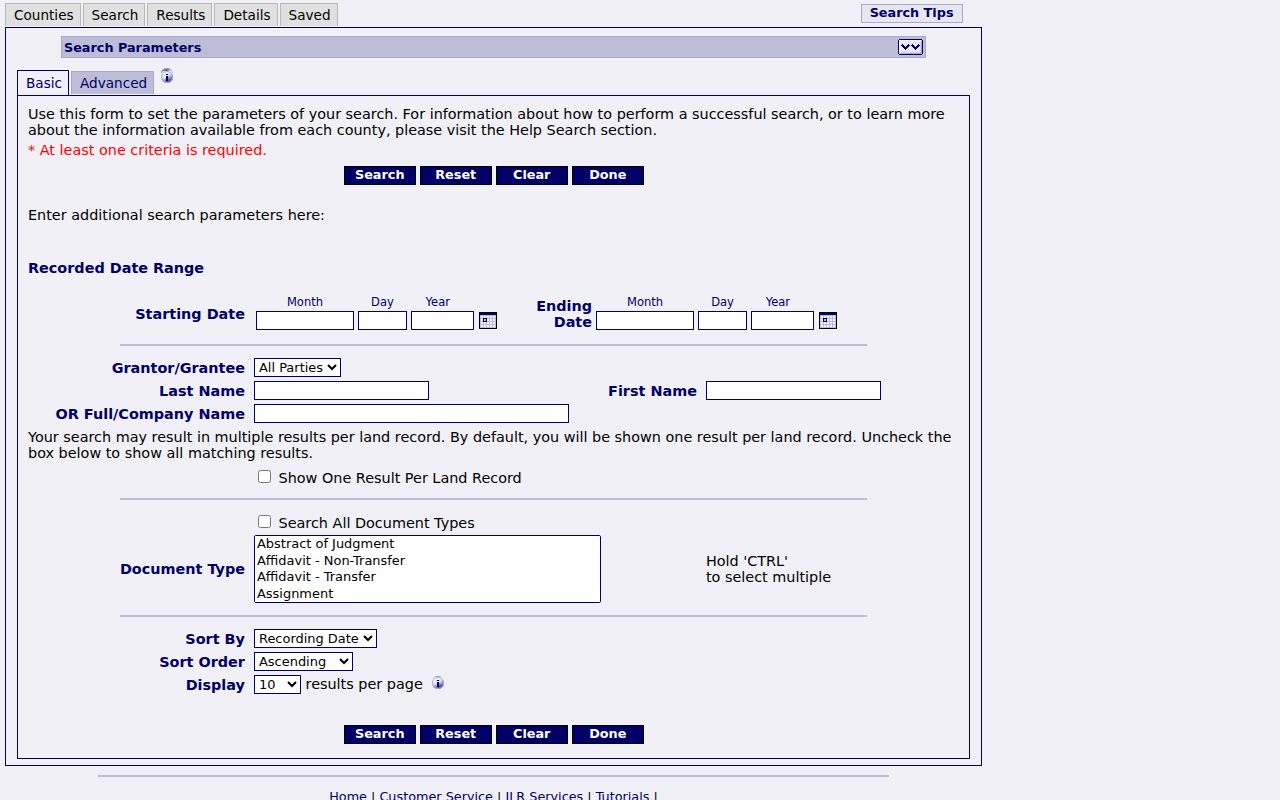
A result remains an index lead, not proof of title, current ownership, or a guaranteed legal description. An images-only filter may hide indexed entries without a displayed image. If an older item is absent, ask the county recorder or consult a local index rather than treating the online screen as the complete history.
For a name-and-address trail, note the county, document type, date window, party role, and whether an image is available. The county recorder directory identifies the local office for copies and older indexes.
| Portal control | Input or option | Search note |
|---|---|---|
| Counties and document types | County selection; document-type multi-select | Choose the relevant county and instrument types rather than assuming every record category is selected. |
| Recorded dates | Start and end month, day, and year | A date range narrows the recording index, not necessarily the event date. |
| Party role and name | Grantor or grantee; last and first name, or full/company name | Search both roles and spelling variants when tracing a transfer. |
| Result options | Images-only and one-result-per-land-record checkboxes | Filters change what appears; images-only can conceal index-only entries. |
| Sort and page controls | Sort/order and results per page | Use Search, Reset, Clear, and Done as needed; account features and daily view limits apply. |
Note: The portal's free index locates a possible instrument; the recorder's copy and legal description still need a separate check.
Iowa Deed Records Differ by County
The statewide portal does not promise the same online years or images in every county. County pages show why a street search needs a local date check. Iowa County's record page describes records extending back to 1838. Polk County's online real-estate index starts in 1992, with older material handled through imaging or microfilm. Lee County describes a record-room image collection covering 1836 through 1983. These are local examples, not a common Iowa cutoff.
Use the Iowa county recorder directory to find the office for the parcel's county, then confirm that county's dates, image route, copy options, and fees. A search window should reflect the known transaction period, but it should not stop at the first online year if an earlier owner matters. A county may expose a name index while keeping the underlying image or older book at the counter.
Iowa Land Records lists documents from county recorder systems, but each office still controls local records and certified copies. Keep county, date, and source together when comparing a deed with the assessor. A transfer recorded later than a sale or move can make two otherwise accurate records look out of step.
Iowa Street Guides Across Time
A historical city directory can add a dated address clue, especially when a volume includes a street-and-avenue guide. Des Moines Public Library reports digitized city directories from 1866 to 1922, microfilm from 1866 to 1935, print Central directories beginning in 1910 and continuing to the present, and phone directories from 1957 forward. It describes alphabetic listings for private citizens and firms, plus civic and business material. The exact year and page still need to be checked in the volume.
For a street search, preserve the printed spelling, abbreviation, publisher, year, volume, and page. Compare adjacent years when available. A directory entry may reflect a publication cutoff, a boarder, a business, or a mailing address. It does not establish ownership or uninterrupted residence. Polk County's city directories and land and lot indexes are distinct series with distinct dates, so one should not be used as a substitute for another.
The Iowa city directory guide follows the historical collection shelves in more detail. Use the Des Moines Public Library directory guide to identify its formats and holdings before searching a particular year.
Iowa Voter Lookup Limits by Address
The Iowa Secretary of State's individual voter check asks for first name, last name, numeric ZIP code, numeric house number, and date of birth by month, day, and year. It returns that person's registration and polling details. It is designed for an individual check, not as a public reverse search for everyone along a street. It cannot be used to turn an address into a current-resident list.
A bulk voter-list request is a separate process. State and county lists have different jurisdictional boundaries, and requests must state a permitted political, research, or official purpose. The Secretary of State's voter-list instructions describe contact-only and contact-plus-participation options, status choices, and formats; commercial use is prohibited. Processing can take up to 14 days. Those rules do not make the individual lookup a street directory or show who currently occupies a property.
Use voter information only within its stated scope and do not infer that an inactive or pending registration means someone has moved. A public registration result is one record with a defined date and purpose, not confirmation of a household. The official lookup's inputs and limits should be read before any comparison with property data.
Note: Iowa's individual voter lookup checks registration and polling details for one person; it is not a street-by-street resident list.
Iowa ZIP Changes Affect Street Searches
ZIP codes describe mail delivery, not the boundary of a city or county. A postal city in a geocoder result can differ from the municipality that governs the property. Keep separate notes for the street address, postal city, ZIP, county, and local jurisdiction rather than using one label to stand in for the others.
A dated Iowa example makes this clear: a USPS Postal Bulletin says part of Iowa City's delivery area shifted from ZIP 52245 to 52242 effective November 1, 2008. A historical directory or record may therefore show the earlier ZIP even when a current postal lookup returns another code. Preserve the original form with its date, then verify a current address through the USPS ZIP Code Lookup.
This difference matters when matching a street across older directories, deeds, and present maps. A ZIP match can help locate an address, but it cannot show that two records refer to the same municipal boundary or resident. For a parcel, the local assessor or GIS jurisdiction remains the relevant source.
Iowa Public Record Request Route
If an index or image is not online, identify the office that keeps that specific record and ask about its local search route. Iowa Code chapter 22 requests to an identified custodian can be made in person, in writing, by phone, or electronically. A requester generally does not have to give a purpose or show identification. The custodian does not have to create a new record or perform a custom analysis, and confidential information may be withheld or redacted.
Keep the request narrow: name the record type, the address or parcel, the county, and a date range. Ask whether the office can inspect the record, provide an image, or issue a certified copy, and request a cost estimate before ordering copies. Iowa law permits reasonable direct costs. Each office sets its own practical process, and local fees or coverage years should be checked with that custodian rather than copied from another county.
The Iowa Public Information Board's chapter 22 guidance explains request methods and common limits. It is a statewide guide; the recorder, assessor, auditor, or treasurer holding the record remains the office that can confirm its own files.
Iowa Street Record Terms
These terms appear across assessor cards, maps, deeds, and historical directories. Keeping them distinct makes it easier to compare a street record without claiming more than the source supports.
- Parcel
- A mapped or assessed unit of property identified by a local parcel number or PIN. A parcel is a property record unit, not a household.
- Situs address
- The physical location assigned to a property record. It may differ from the owner's mailing address or from the postal city printed in a mailing address.
- Plat
- A recorded subdivision map that can identify lots, blocks, and related legal descriptions. Compare the document and map; a GIS line is not a survey.
- Criss-cross directory
- A reverse directory arranged by street address, often connecting an address with a listed name for a particular year. Coverage and conventions depend on the book.
When two sources use different terms or address formats, preserve each source's wording first. Then use parcel number, lot and block, legal description, or a dated map to see whether they refer to the same place. Do not silently convert a mailing address into a situs address or a directory entry into proof of title.
What Iowa Street Records Cannot Show
No single Iowa source supplies a complete, current list of people living along a street. Assessor and deed records concern property and recorded parties. A voter self-check concerns one person's registration. A directory gives a dated printed entry. These sources can support personal research, family history, or civic understanding, but they cannot be joined into a guaranteed list of every occupant or used to claim continuous residence.
Some people have added privacy protections. Iowa's Safe at Home program provides a substitute address and confidential voter-registration and absentee mechanisms for qualifying survivors. Its participants must not be exposed or treated as a gap to work around. A search result that is absent, masked, old, or incomplete is not permission to seek out protected information through another record.
Keep a street directory search limited to a lawful, specific purpose. Verify facts with the office that holds each record, avoid republishing personal details, and do not use address information to stalk, threaten, or harass anyone. If a record is sensitive or its permitted use is unclear, ask the custodian how to proceed.
Respect privacy. Use street and address records only for lawful personal research. Do not use them to stalk, threaten, or harass another person, and never publish a Safe at Home participant's protected address.
For a safe search, keep the record's date and limits with it, and share only what is needed to explain your source.