
What an Iowa Resident Lookup Can Confirm
No Iowa file names every resident. Records tie people to events, cases, elections, credentials, or places; compare clues.
| Record | What It Confirms | Where | Access |
|---|---|---|---|
| Vital record | Birth, death, marriage, or family event | Iowa HHS or county recorder | Restricted; age and eligibility rules apply |
| Court docket | Case parties, roles, status, and events | Iowa Courts Online; filing-county terminal for documents | Free docket; document access has limits |
| Voter record | Individual registration and polling details | Iowa Secretary of State lookup | Self-check, not a reverse directory |
| Deed or parcel | Recorded parties and legal description | Iowa Land Records or county recorder | County and image coverage vary |
| Professional license | Credential and status | Iowa DIAL or Department of Education | Some personal fields are confidential |
| Historical source | Name tied to a year or place | State Historical Society or local repository | Collection scope and access vary |
Iowa Resident Lookup: Search Iowa Courts Online
Iowa Courts Online offers a free statewide trial-court docket with no registration or subscription. Name search needs first and last; middle is optional and can use a wildcard. Filters include exact DOB, role, county, case type, and aliases. Preserve variants; a common name cannot identify a person.
| Search path | Fields described by the court | Useful check |
|---|---|---|
| Name | Last name, first name, optional or wildcard middle name, exact DOB, role, county, case type, and aliases | Keep filters and spelling with the search date |
| Case ID | County, case type, and a 17-character uppercase ID | Use the full identifier; a partial name is a different route |
| Citation | Citation search options in the court tools | Citations can take 14 to 21 days to show in public payment search |
The Iowa Courts Online help page explains public access and field behavior. Court support is available at support@iowacourts.gov or 1-800-831-1396, Monday through Friday, 7 a.m. to 5 p.m.
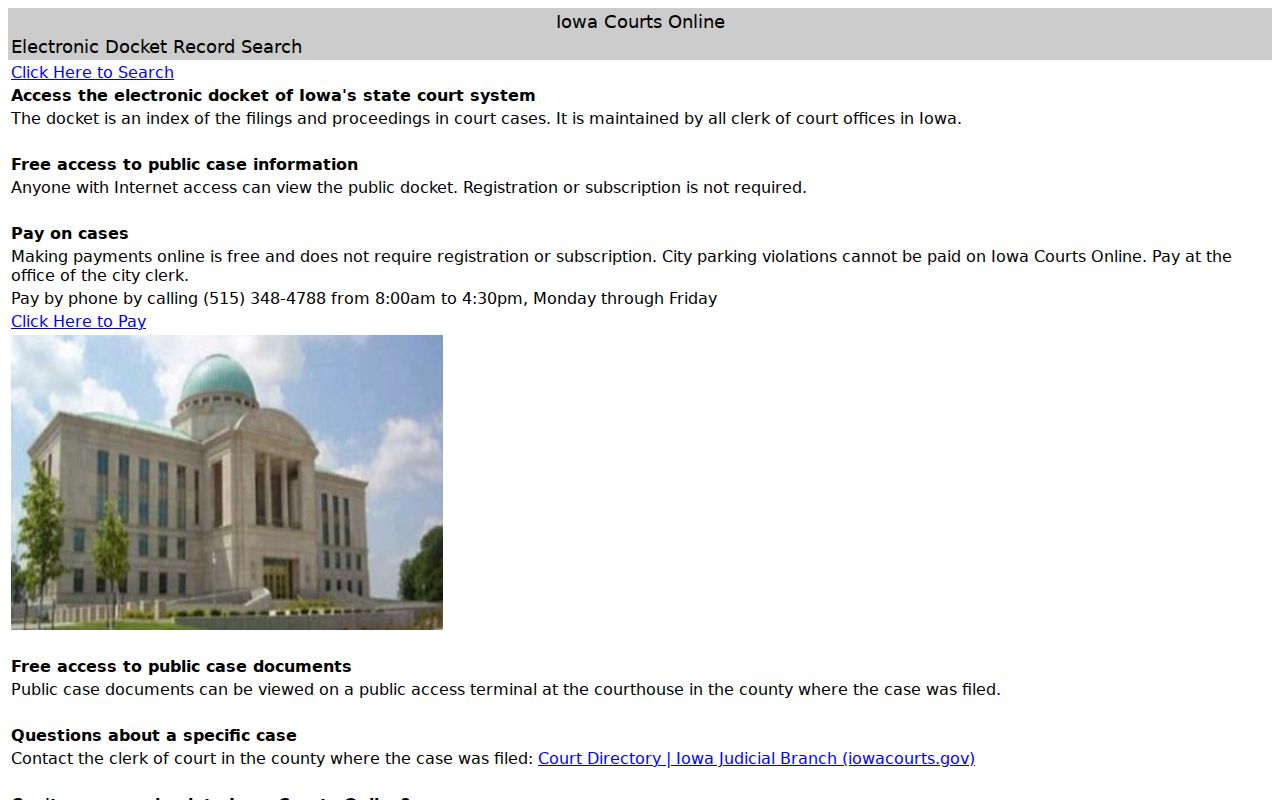
The help guide also lists the full case-ID format.
The Iowa Docket Does Not Include Every Filed Document
A docket is not a document image. Public filings are generally at the filing-county courthouse terminal; sealed or restricted items remain unavailable, and not every image is online.
Advanced Case Search costs $25 per month and adds parties, lis pendens, judgments/liens, exhibits, financial and service-return details, traffic, case types, and schedules. It does not provide documents. Federal cases use PACER or a district court. Northern District cases before 2004 may not be electronic; older files may be at the National Records Center. A 2008 Cedar Rapids flood destroyed some “Flood Files”; ask the clerk about a specific file.
The free Iowa payment search separates name from case or citation queries.
| Payment search route | Inputs described | Limit to remember |
|---|---|---|
| By name | County, first name, last name of at least two characters | Common names may need a second identifier |
| By case or citation number | Full case ID or a partial citation using the last four to six digits | Citations can take 14 to 21 days to appear |
This is a field inventory from Iowa's court guidance, not a made-up result for a named person:
| Result type | Fields documented | What the result does not establish |
|---|---|---|
| Public docket | Case number, parties and roles, docket events, status, basic case detail | Every filed document or a person's identity based on name alone |
| Citation or payment search | Citations and payment-search results reached by name, case, or citation route | A complete case file or an immediately current citation record |
| Public case documents | Documents available at the courthouse public terminal in the filing county | Sealed or restricted papers, or a promise that every image is online |
The Iowa Courts Online payment screen shows the separate name and case-or-citation tabs.
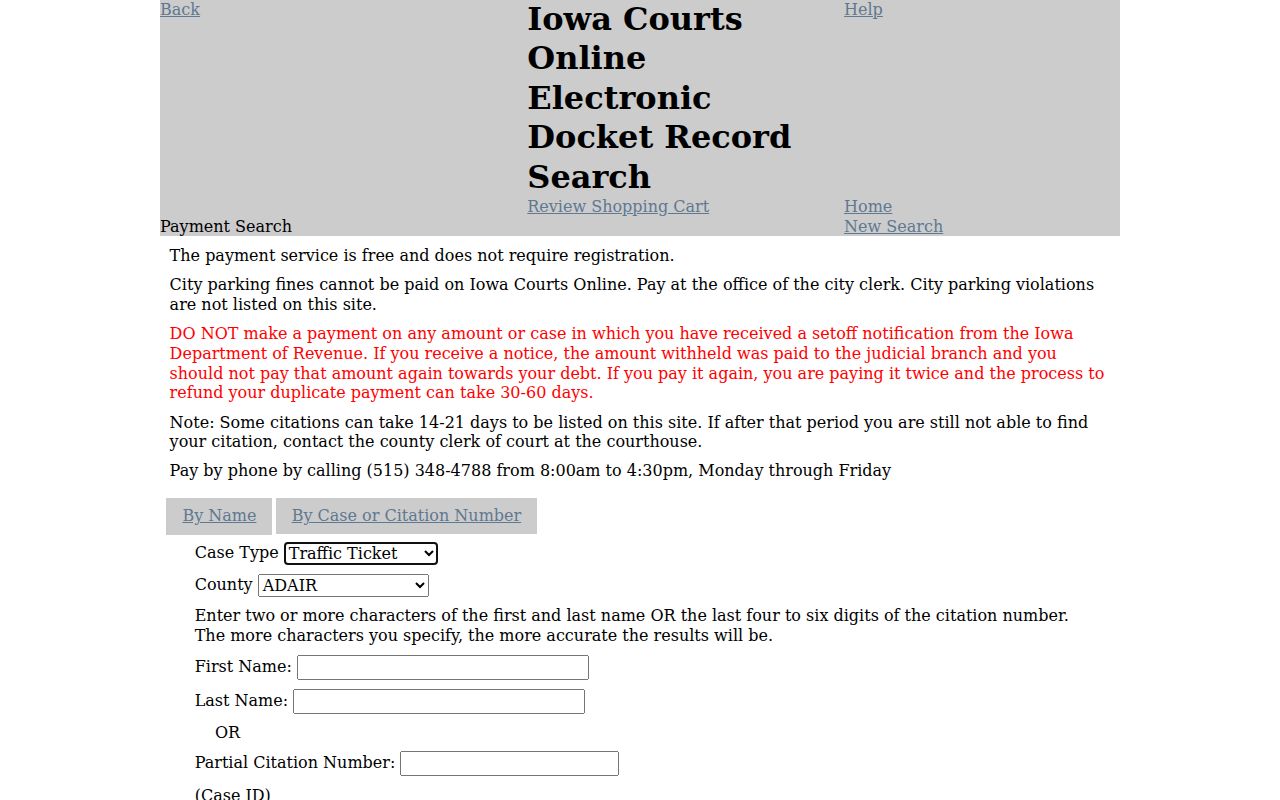
The payment screen is separate from the filing-county terminal for public documents.
Iowa Resident Lookup: Verify Your Voter Record
The Secretary of State's individual tool checks registration and polling details, not public reverse lookups. Its required inputs are listed below.
| Individual lookup field | How it is entered | Purpose |
|---|---|---|
| First and last name | Name fields | Identify the voter record to check |
| ZIP code and house number | Numeric address inputs | Support the individual address check |
| Date of birth | Month, day, and year | Complete the individual's lookup inputs |
The Iowa voter lookup shows the individual-check fields. Use it to confirm your own registration or polling details.
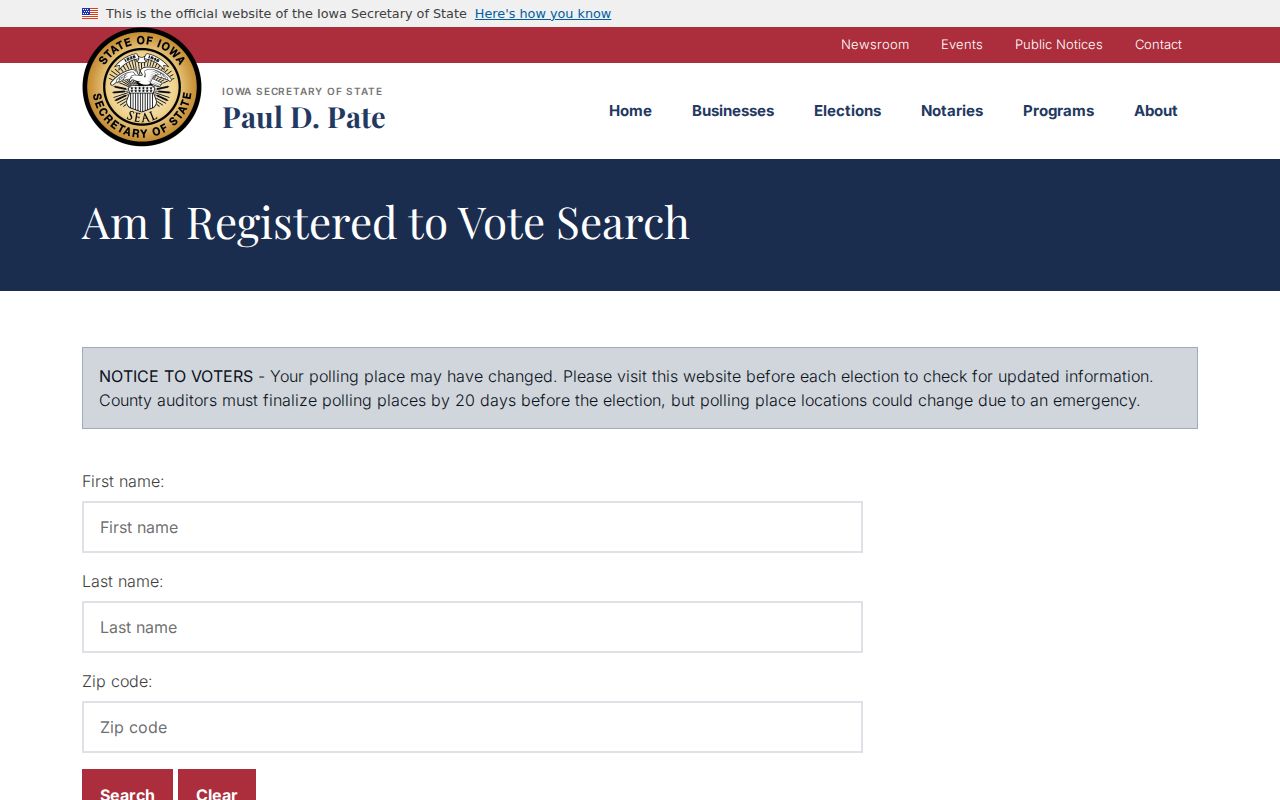
This form is for a voter's own check. Bulk lists are paid, limited to permitted political, official, or bona fide research uses, and barred from commercial use. Processing can take up to 14 days. The $10 minimum covers up to 20,000 records, with added fees. County auditors provide county lists; see the Secretary of State's voter-list instructions.
Iowa Resident Lookup: Use HHS for Vital Records
Iowa HHS Bureau of Health Statistics began registering events on July 1, 1880 and works with county recorders. Vital records confirm events and family context, not living residents as a group. Current HHS guidance charges $20 per search, including a copy if found or a no-record letter if not; an older PDF still shows $15.
The Iowa HHS certified-record request page lists ordering channels and current requirements.
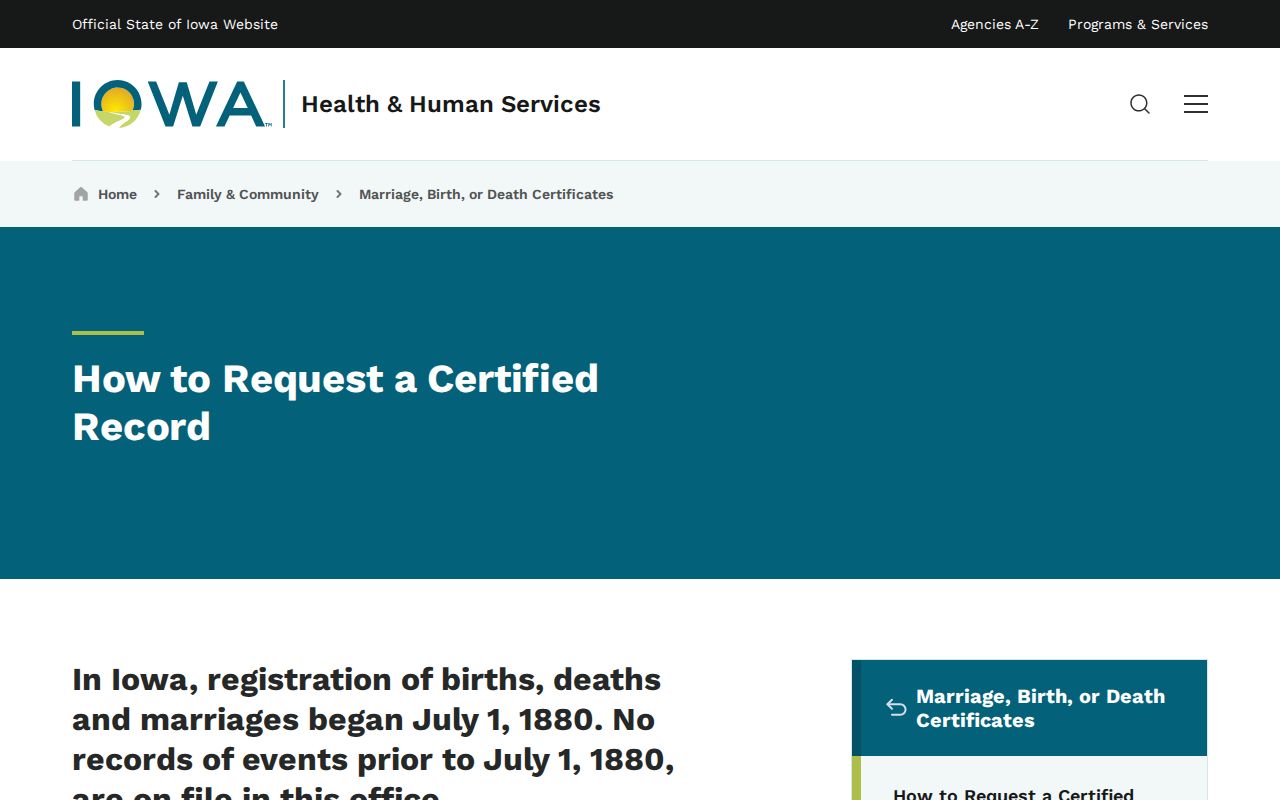
The current HHS page sets the fee; use the table to choose an eligible request route.
| Need | Route | Key limit |
|---|---|---|
| Eligible certified copy | HHS, qualifying county recorder, mail, phone, or in-person service | Eligibility, identity proof, payment, and notarization may apply |
| Online order | VitalChek, the only online third-party service HHS authorizes | Its convenience fee is additional |
| Genealogy search | Mail to HHS using the event, person, date, and place information | Statewide from July 1, 1880 for births, July 1, 1904 for deaths, and July 1, 1916 for marriages; older requests need county, year, and name |
| Historical access | HHS or historical collections, based on custody and record age | Birth, marriage, divorce, and annulment open at 75 years; death and fetal death at 50 years, subject to law |
Mail requests need an application, ID, payment, and notarization where stated; phone orders have a separate fee. At the Lucas State Office Building, eligible weekday requests received before 2 p.m. can take about two hours. County recorders commonly hold births from 1986 and deaths and marriages from 1954, with exceptions for adoption, legal-name-change, delayed, sealed, some single-parent, and 1921 to 1941 records.
HHS genealogy guidance describes mail-only orders. Eligibility covers the named person, spouse, children, parents, grandparents, grandchildren, siblings, or authorized representatives and guardians with proof. These searches are not same-day, and an index is not a certified copy.
Verifying the Name Behind an Iowa Resident Lookup
Names repeat. Keep each source, date, spelling, and filter, then compare an independent clue before connecting a record to a person.
- Preserve the name's spelling, initials, suffixes, and aliases.
- Add a separate clue: county and age, spouse or parent, case ID, parcel description, business filing number, or directory street and occupation.
- Search the fitting record type, then compare a second source from the same period.
- Save the date, terms, filters, and coverage; a blank result does not prove absence.
Vital records show events; deeds name parties and legal descriptions; dockets identify case parties; directories tie names to places; business filings show entity roles; voter records hold election fields. None proves identity alone. For street-level records, see the Iowa street directory page.
- Docket
- A court's index of case events and status, not every filed document.
- Index
- Search fields that point to a record but are not the record image.
- Image
- A published scan of a source document, when one is available.
- Certified copy
- A copy authenticated by its custodian; a portal printout is not automatically certified.
Keep stale, sealed, redacted, incomplete, or misrouted matches tentative. Ask the custodian to resolve conflicts.
Iowa License Searches Show Credentials, Not Residence
Iowa DIAL searches covered professional credentials. Results can reach 10,000; engineers and land surveyors use a P prefix on license numbers.
| Lookup | Fields | Use with care |
|---|---|---|
| DIAL by name | First, board, last, status, company/full name, city, state, ZIP, last-name group | Large result sets and board scope can affect what appears |
| DIAL by number | License number | Engineers and land surveyors use a P prefix |
| Educator license | Separate Iowa Department of Education search | Do not assume an educator credential is in DIAL |
A license hit is not proof of residence; absence may reflect board scope, privacy, or name variation. Verify status with the board. Educators use the separate Iowa Department of Education search.
After 2025 legislation, Iowa Code §10A.508 protects licensees' and applicants' DOB, home address, phone, and email/contact details. Do not republish those fields.
Where Iowa Archives Extend a Name Search
The State Historical Society of Iowa county-record guide covers all 99 counties and describes original and microfilm birth, marriage, death, will, probate, naturalization, land, and court records. Each series has its own dates; the guide is not a statewide name index.
Start with the county-record guide and note the series and years before a visit or request.
Iowa state censuses survive for 1856, 1885, 1895, 1905, 1915, and 1925. The first federal count was the 1840 territorial census; 1890 is missing. Early counts may name only a household head. Federal images through 1950 are online, but a census is not a full person search.
On September 14, 2026, State Historical Society access was limited by a storage move. Contact the Research Center five days ahead; same-day retrieval varies. The Des Moines Public Library guide describes its formats. Local libraries, FamilySearch, and Ancestry vary in access. For directory years, use the Iowa city directories page.
Privacy Limits on an Iowa Resident Lookup
Under Iowa Code chapter 22, requests for existing records can be made in person, in writing, by phone, or electronically; a name or purpose is generally not required. Identify the custodian and record; an office need not create or combine data. The Iowa Public Information Board explains access and exceptions. Social Security numbers and confidential addresses may be withheld. Chapter 715D gives covered consumers access, correction, deletion, portability, and opt-out rights, with specified exclusions for government and public records. Do not republish sensitive fields.
Safe at Home gives qualifying survivors of domestic violence, sexual assault, trafficking, stalking, or assault a substitute address, mail forwarding, and confidential voter registration for four years. Never use an ordinary lookup to uncover or work around a protected address.
The Safe at Home enrollment page describes the confidential route without exposing participant records.
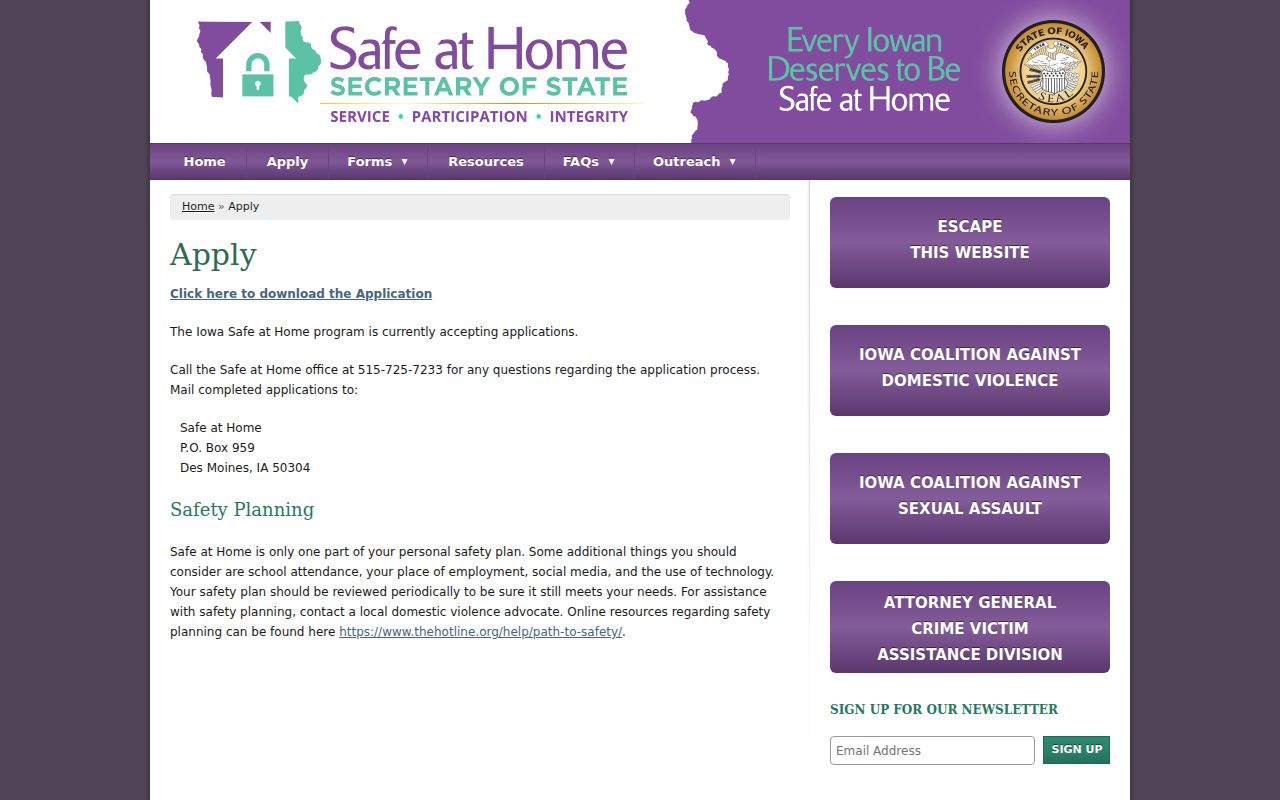
The screenshot shows enrollment for eligible participants, not access to confidential addresses.
Lawful personal use. Use public records for a legitimate personal, family-history, or civic purpose. Do not use an Iowa resident lookup to stalk, harass, intimidate, expose a protected address, or evade a confidentiality program.
Iowa DOC Search Has a Narrow, Dated Scope
Iowa DOC Offender Search covers state prison and offender records, apart from Iowa Courts Online and county jails. Fields are first, middle, and last name; offender number; sex; location; offense; and commitment county. The page says records update weekly and may not be accurate or complete. A name alone is not a match.
The Iowa DOC search form shows the supported name, number, location, offense, and county fields.
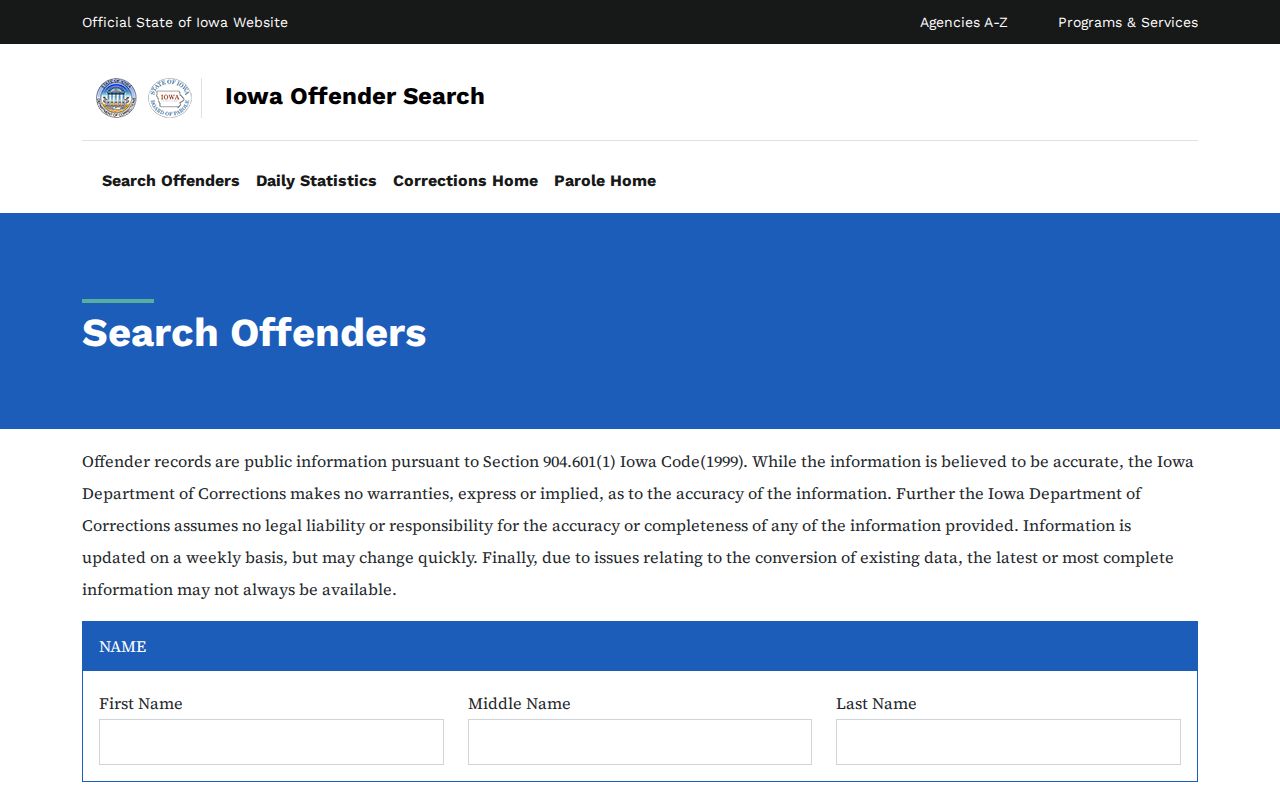
Record the date and compare the offender number. Jail rosters are county-specific; Iowa has no single statewide list.