
Iowa Previous Residents by Era
One address rarely has a single source that reaches from its first use to today. Iowa has territorial and county records before a stable city directory, then state censuses and printed address books, then more local portals. These dates are a research sequence, not a promise that every Iowa county preserved every series. The table separates what each source can establish from the place that holds it.
| Source | Years It Covers | Where Held | What It Shows |
|---|---|---|---|
| Iowa Land Records and local recorder indexes | Years vary by county; Polk online index 1992-present | Statewide portal and county recorder | Recorded parties, dates, instrument references, and legal descriptions |
| Polk County land and lot indexes | Land 1848-1952; lot 1851-1959 | Polk County archive | Separate name/instrument and lot-based trails |
| Des Moines city directories | Digitized 1866-1922; microfilm 1866-1935; other runs vary | Des Moines Public Library and Polk County collections | Printed name, year, address, occupation, and street guide |
| Iowa state and federal censuses | State: 1856, 1885, 1895, 1905, 1915, 1925; federal through 1950 | State Historical Society, archives, libraries | Household and county context for a census year |
| County deeds, probate, and court series | County-specific; guides identify preserved dates | Recorder, clerk, or SHSI county holdings | Transfers, estates, cases, and records that may connect a household to a place |
For a recent owner, begin with the assessor parcel and the current deed index. For an older Iowa household, pick the nearest directory and census year, then check the county record guide for deed, probate, tax, or court material. A national census gap or a county's missing online years may require a different series, not a broader name search.
Before statehood, territorial and early county books may matter more than a directory. The Iowa sequence begins with territorial government in 1838 and state government in 1846. By the late 1800s, printed directories, newspapers, vital indexes, and state census years offer more name-and-place links. Later records become easier to search online, but they can have tighter privacy rules. A source-year table keeps these shifts visible when you compare Iowa previous residents across a long span.
Iowa Past Residents: Polk County's Record Clocks
Polk County has several useful date spans, but they are not one continuous index. Its land index runs from 1848 to May 1, 1952, and the lot index from 1851 to July 24, 1959. Des Moines city directories held by the county and library cover different years again. The online recorder index starts at 1992 for Polk real-estate records, while older copies go through the imaging or microfilm route.
This difference is an Iowa-specific search tip: choose the series that fits the question. A lot index can orient a parcel within a plat; the recorder index points to an instrument; a directory places names in an address book. A break between those date spans is not proof that no one owned or lived at the address.
The statewide Iowa Land Records site does not publish one starting year that applies to every county. County examples show why. Iowa County reports records back to 1838, Polk's online real-estate index begins in 1992, and Lee County describes images from 1836 to 1983 in its local record room. Those collections answer different date and record questions. For a house in Polk County, older lot-index entries may help identify the parcel before a recorder image is available; for another county, start with that county's own page.
Trace Iowa Previous Residents Through Deeds
A chain of title is the sequence of recorded transfers tied to a parcel. Start with a current parcel identifier or legal description, since an old street number may not match today's label. Iowa Land Records searches all 99 counties, but a county recorder may still hold older books, unposted images, or certified copies. Its index can name a grantor and a grantee, the parties transferring and receiving an interest.
- Use the local assessor to note the parcel number and legal description for the current tract.
- Search the county and a date range in Iowa Land Records; try the current owner as grantee.
- Read the instrument's grantor, recording date, document type, and legal description.
- Search the prior owner as grantee to find the deed before that transfer; repeat by recorded date.
- When online years stop, ask the county recorder for local index books, images, or microfilm.
In Iowa Land Records, select a county and document type, set a recorded-date range, then choose grantor or grantee and enter a name. The portal also has images-only and one-result-per-land-record options, sorting, and page-size controls. A basic unregistered search is limited; an account adds advanced and saved features but still has daily document-view limits. Search both names on the deed and retain the instrument reference before moving to an earlier seller.
- Grantor
- The party named as transferring an interest in a recorded instrument.
- Grantee
- The party named as receiving that interest.
- Legal description
- The land description tied to a tract, lot, or survey; it can be more stable than a street label.
- Chain of title
- A sequence of recorded interests; it does not establish every person who lived on the parcel.
Iowa City Directories Place Past Residents
A directory can add the household layer a deed lacks. Des Moines volumes list names with addresses and often occupation or business details; later volumes include a street-and-avenue guide. Preserve the year, publisher, page, spelling, and any abbreviation as printed. An address entry could refer to a renter, boarder, business, or mailing point. It does not show legal ownership or continuous residence.
The full shelf map belongs on the Iowa city directory collections page. Here, use a directory year to test a name found in a deed or to locate a household between census counts. Polk County's suburban runs cover different dates from Des Moines volumes, so check the city and edition before treating a blank year as a move.
Publisher and year are part of the evidence. A name printed by Mills, Bushnell, or R.L. Polk may be sorted differently from one in a later volume, and abbreviations can shift. Preserve what the volume says, including its page number and street spelling. The Des Moines street-and-avenue guide can help locate a number in its own edition; do not assume the same guide or print date exists in every Iowa city.
Iowa Past Residents Across Directory and Census Years
Directories are often annual, while census schedules provide a household snapshot at a set enumeration. Pair the nearest available records and write down the gap between them. A directory can show a name at an address in one year; a census can add household members and age context at another. Compare the address, spelling, occupation, and family names before linking entries.
Federal census images are released under a 72-year rule, with online federal coverage through 1950 in the research inventory. Earlier Iowa schedules may not name every household member: some early counts list only the head. State census schedules add dates not supplied by a ten-year federal count. Treat each enumeration as a snapshot, then use land, probate, directory, or vital sources to bridge the years between it and the next record.
- Find the first directory year that places the name at the street address.
- Note the volume, publisher, page, occupation, and any street-guide entry.
- Compare the nearest Iowa census year and keep its county and household details.
- Check the next directory year for a move or a new household member.
- Use probate, a newspaper notice, or another county record to resolve a gap.
These steps help distinguish one person from a same-name neighbor. They do not make an address trail complete when a source omitted a resident or a volume is missing.
Iowa Previous Residents and the State Census Gap
The missing 1890 federal census changes the middle of many Iowa family searches. Iowa's state count for 1885 can be compared with 1895, then with 1905, 1915, and 1925. The federal census begins with an Iowa territorial enumeration in 1840, and some early schedules record only the head of a household. A gap in one census series is a reason to check state and local records, not to assume the family moved.
Iowa began territorial administration in 1838 and became a state in 1846. Before a printed city directory existed for a place, county land, probate, court, naturalization, church, or cemetery sources may be the better route. The years available differ by county and collection.
Iowa's 1856 count predates the later sequence of 1885, 1895, 1905, 1915, and 1925. Selected local counts from 1836 to 1897 can also help, though the county and series must be checked. A gap between 1885 and 1895 is not a dead end when an address, deed, probate file, or local paper survives. The point is to label the source and year, not fill a missing federal row with an unsupported guess.
Iowa ZIP Changes Can Mimic a Move
A postal change is not always a household move. A USPS bulletin records an Iowa City delivery-area shift from ZIP 52245 to 52242, effective November 1, 2008. Keep the ZIP printed in a directory or dated record instead of replacing it with a current code. ZIP geography serves delivery routes and can cross local boundaries; it is not a legal address history or proof of city limits.
For a current delivery label, use the USPS address and ZIP lookup. For a past occupant, keep the dated directory entry and compare it with the deed or census rather than reading a different ZIP as proof that a resident left.
The Iowa City change is a postal-area adjustment, not evidence that a household moved or a municipal border shifted. A dated source can carry an old ZIP even when today's mailing label differs. Keep the house number and street name as printed, then compare the parcel description and year. The statewide ZIP appendix and current USPS lookup answer separate questions, so use the historic value when reading an older address record.
Iowa County Records Back Earlier Deeds
The State Historical Society of Iowa's county guides describe microfilm and original holdings for deeds, probate, court, naturalization, and vital records across all 99 counties. They help identify the right series when an online recorder index ends or a search result has no image. The office or repository holding the material can explain whether it offers inspection, a copy, or certified service.
The SHSI county-record guide links collections by county. Its current research-center notice says archive access is limited during a storage move and asks researchers to contact staff five days ahead. Review the research-center access details before traveling.
The county guide can point to deeds, wills, probate, naturalization, court, vital, and tax series preserved on microfilm or as originals. A repository may require a series name, county, date span, or volume reference to find the right item. For Iowa previous residents, use the guide first to learn what has survived, then ask the record holder how to inspect it and whether copying or certification is available. Access to books and microfilm may differ from retrieval of archival boxes.
For a current parcel and recorder route before tracing ownership backward, see the Iowa street address directory.
The State Historical Society's county-record guide is shown below. A county page narrows the search to local series; it is not a substitute for the county recorder's current fee and access instructions.
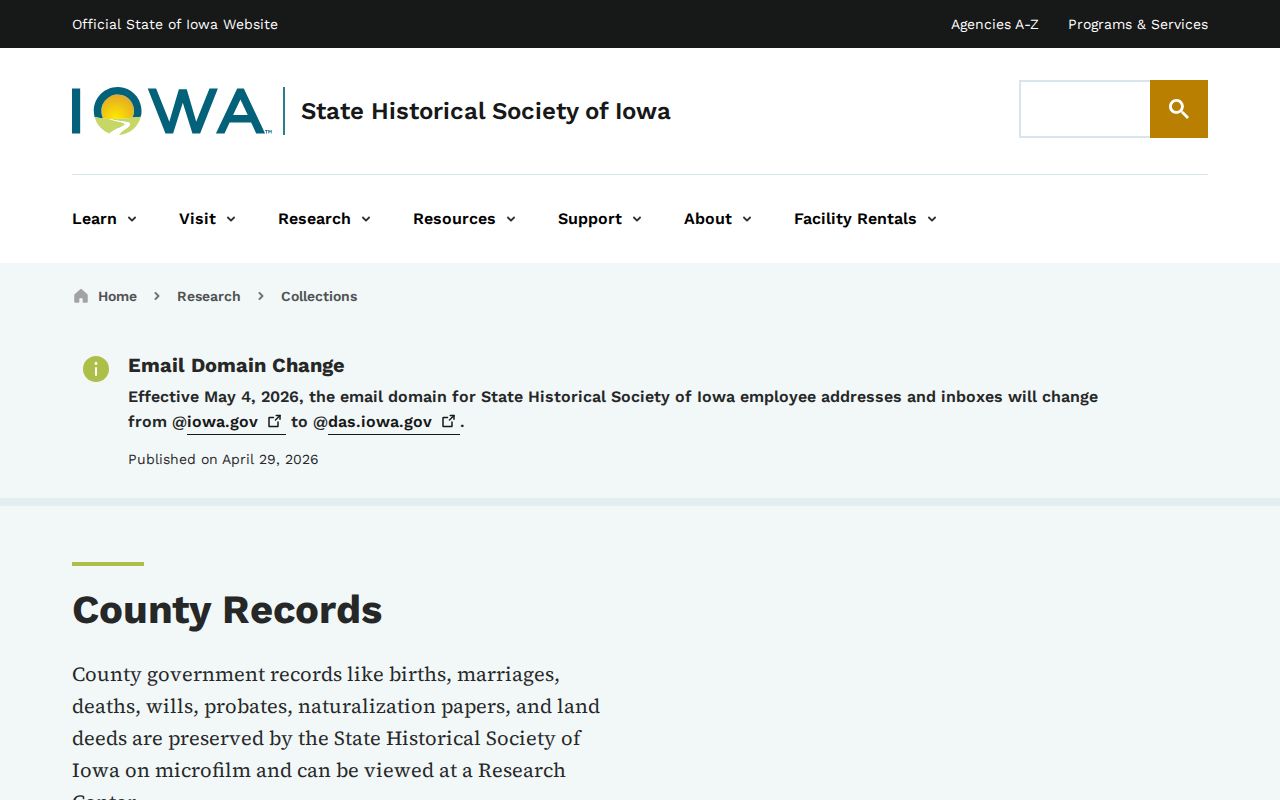
Use the guide to find the series name and dates, then ask the named holder about the relevant reel, book, or copy process.
Iowa Record Requests Have a Local Route
If an older book, copy, or image is not online, ask the custodian that holds the county record. Iowa Code chapter 22 allows a request in person, by phone, in writing, or electronically, and a requester generally need not identify themselves or state a purpose. Name the record type and years, and say whether you seek inspection, an image, or a certified copy. The custodian does not have to create a new index or conduct open-ended research.
Fees depend on actual direct and reasonable costs, including copying or staff time when allowed. Ask for an estimate before sending a broad request. A clerk or recorder may need to redact protected information, and some records remain closed under a specific rule. The Iowa Public Information Board's chapter 22 guidance explains requests, fees, delay, and exceptions.
Chapter 22 does not set one flat charge or one deadline for every request. IPIB advises prompt acknowledgment and rolling production; delay depends on the request and any needed confidentiality review. Its guidance says ordinary delay should not exceed 10 business days in the circumstances described, and a good-faith confidentiality delay has a 20-calendar-day limit under the statute. Ask which exception applies if an office withholds a record, and do not ask for private identifiers or protected addresses.
Past Iowa Households Need More Proof
Ownership and occupancy are different questions. A recorded deed names parties to a transfer; a directory entry can place a household member at an address; a census gives a dated household view. Read each source for what it actually records. If the trail ends, obituary notices, cemetery surveys, probate files, newspapers, and local tax or court records may offer another lead, but availability varies by county.
Previous residents should be researched for family history, estate work, or a property's history. Do not use an address trail to track, threaten, or harass someone. Iowa public records can be restricted, redacted, or confidential, and a record's public status does not erase those limits.
A vital record or probate file may confirm a family event, while an obituary or cemetery survey may help close a trail after a person leaves an address. These are leads with their own coverage and access rules. HHS limits access to recent Iowa vital records by relationship and proof, and age thresholds apply to historical records. A directory entry, a deed, and a public index should stay in their separate roles when you describe who lived in an Iowa house before.
Lawful use. Use Iowa records for personal research and house history. Do not use them to stalk, harass, threaten, or harm a living person.