
Iowa's City Directory Shelf by Collection
There is no single Iowa volume set or statewide publication run. Start with the town or city where a person lived, then check the library or archive that serves that place. Des Moines has unusually well-described overlapping formats; other communities have separate, unevenly surviving runs.
| Collection | Years | Where Held | Access |
|---|---|---|---|
| Des Moines digitized directories | 1866–1922 | Des Moines Public Library | Online collection; confirm the year and volume shown |
| Des Moines Central print directories | 1910 to present | Des Moines Public Library | Print series; ask the library about the needed year |
| Des Moines microfilm | 1866–1935 | Des Moines Public Library | Microfilm; confirm current reader access with the library |
| Des Moines telephone directories | 1957 forward | Des Moines Public Library | Library collection; year coverage differs from city volumes |
| Polk County city and suburban runs | Des Moines 1920–2002; suburbs 1963–2002; West Des Moines and Polk City 1998–2002 | Polk County archives | Separate archive series; consult the collection description |
| Directories for other Iowa cities | Varies by place and year | Local libraries, county historical societies, universities, and the State Historical Society of Iowa catalog | Search by city and inspect the holding record |
These rows overlap and are not a promise of an unbroken sequence. A print year, digitized year, microfilm year, and telephone-book year describe different formats, and a gap in one format may be covered by another. Do not assume a title continued every year or that a Des Moines run covers all of Iowa. For a smaller city or county seat, ask whether the catalog record describes an original, a reel, a scan, or only a partial index before planning a search.
Des Moines Editions and Publisher Changes
The Des Moines shelf gives researchers a useful view of how publisher, title, and format change over time. The library identifies Mills & Co. for 1866 and 1869, J.P. Bushnell in selected years from 1871 through 1889, and R.L. Polk in many editions from the 1890s into the 1920s. These are named examples within surviving runs, not a claim that every year was issued or retained.
| 1866 and 1869 | Mills & Co. editions are among the early recorded Des Moines volumes. |
|---|---|
| Selected 1871–1889 years | J.P. Bushnell appears in the publisher history for some years in this span. |
| Many 1890s–1920s years | R.L. Polk issued numerous editions; the archive record for an individual volume should be checked. |
| 1910 to present | The library separately lists a print Central directory series beginning in 1910. |
| 1957 forward | Telephone directories form another series and should not be treated as identical to the city volumes. |
The Des Moines Public Library directory guide describes the digitized, print, and microfilm formats and the types of material in these volumes. Its collection overview is useful for choosing a starting format, while the volume itself remains the source for a specific year, page, spelling, or entry.
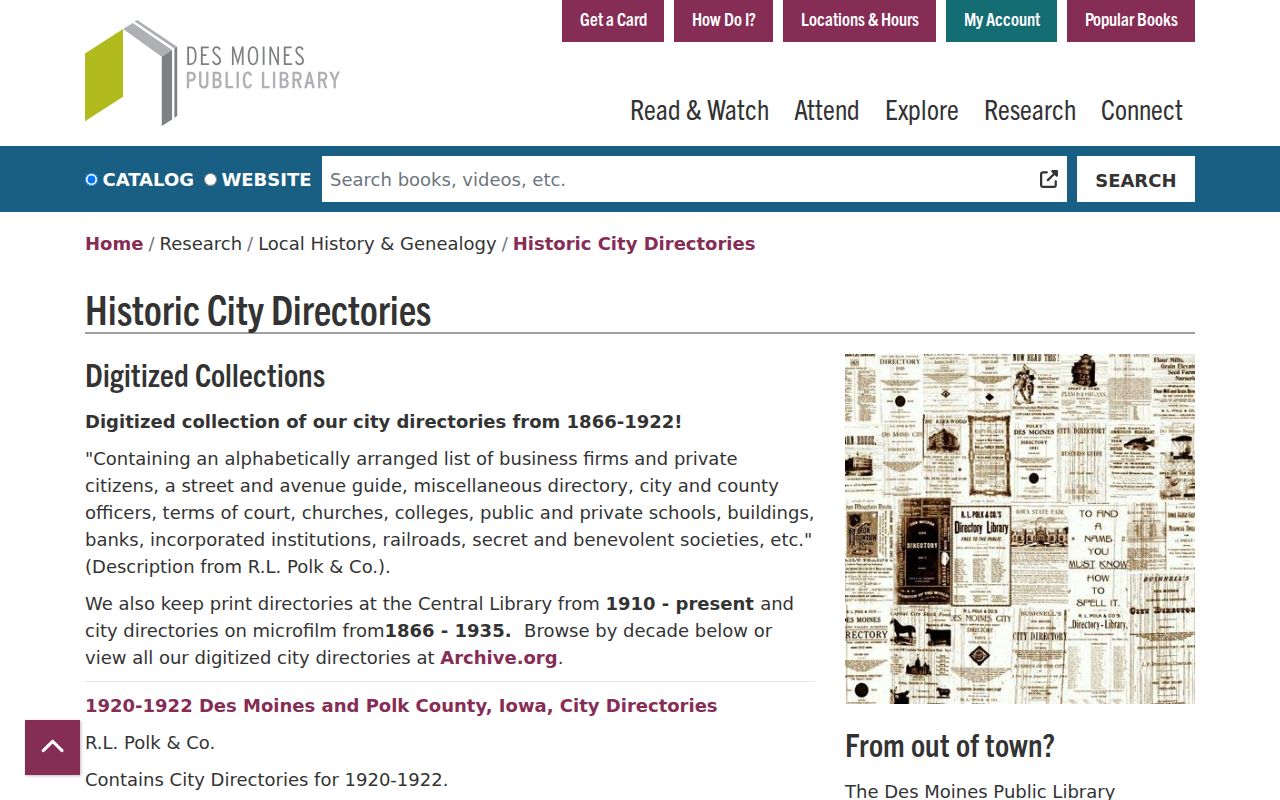
The image shows the library's distinct access paths at a glance. A digital finding aid can point to a year, but it does not make the print or film ranges continuous, so keep the format beside each citation.
Find City Directory Holdings Across Iowa
Outside Polk County, collection work starts locally. Iowa City, Cedar Rapids, Davenport, Council Bluffs, Sioux City, and smaller county seats may each have their own publisher, library shelf, reel, or scanned run. A city name in a catalog is a clue to inspect, not proof that every year or every neighborhood is represented. Search the local public library and county historical society first, then widen to the State Historical Society of Iowa catalog, university collections, and larger digitized repositories.
The State Historical Society's holdings include more than 300,000 books and periodicals, and its catalog lists city and county directories alongside plat maps, cemetery surveys, yearbooks, family histories, and organizational newsletters. The Library of Congress collection description also identifies Iowa telephone and address directories among its digitized material, but its reel, city, and year coverage varies. FamilySearch and Ancestry may surface scans or indexes from archival collections; image access can depend on rights, a participating center, a library visit, or a subscription.
When a search result appears, open the record for the item rather than stopping at its title. Record the city named, dates actually represented, publisher if given, format, repository, and whether the viewer exposes page images. A collection called “Iowa” may hold only one town or institution. Iowa State's student directory series begins in 1901, for example, and can help establish a campus connection; it is not a list of statewide residents.
Research Iowa's Historical Collections in Person
The State Historical Society of Iowa and county repositories help when a name needs context from deeds, probate, census schedules, court records, naturalization files, or tax material. Its county-record collection covers all 99 counties and describes both microfilm and original holdings. Those guides can point to a county series, but the local year span and retrieval method still need to be checked; Iowa does not have one uniform start date for every local index.
As of September 14, 2026, Special Collections have returned to the State Historical Building shelves, while State Archives materials are still moving back; that relocation is expected to finish by late November. State Archives access in Des Moines remains limited during the move. For those items, arrange an appointment and contact staff at least five business days ahead. The published same-day retrieval slots are Wednesday through Friday at 9:30 a.m., 11 a.m., 1 p.m., and 2:30 p.m.; Saturday visitors should request materials by noon on the preceding Friday. Most books and microfilm are browsable on shelves. Cameras may be used without flash, and Des Moines microfilm readers can save material to a flash drive.
For practical planning, separate a book or microfilm request from a request for a relocated archival box. The State Historical Society research-center page has the current visit and access details; recheck it before a trip because a temporary move can change how quickly an item can be served.
How to Read an Entry in an Iowa City Directory
A directory entry is a compact index clue, and the row should be read with the title page, publisher notes, street guide, and any volume-specific key. Des Moines volumes include alphabetic listings for business firms and private citizens, with occupation or business detail and address information. The library also describes a street-and-avenue guide and listings for officers, court terms, churches, schools, banks, railroads, and societies. Formats and entry conventions vary, so the inventory below separates fields reported for these collections from marks that still need inspection in the actual volume.
| Name or firm | Find the printed spelling in the alphabetic listing. The source describes listings for private citizens and business firms. |
|---|---|
| Occupation or business | Copy the description exactly as printed; it can distinguish people with similar names but is not proof of identity by itself. |
| Household role | Record any role the entry states. Do not assume that the first person listed is the only person at the address. |
| Spouse or family reference | Check whether the edition prints one and transcribe it as shown; no standard spouse notation is established across Iowa runs. |
| Address and guide | Keep house number, street name, spelling, and abbreviation. Use the volume's street-and-avenue guide when available. |
| Telephone entry | Note a number only when the volume prints one; the available telephone-book years are a distinct series. |
| Owner or renter mark | No universal mark is established by the collection description. Inspect the edition's own key and never infer ownership from a listing alone. |
| Source citation | Capture title, publisher, year, volume, and page so another researcher can find the same line. |
- Street guide or criss-cross lookup
- A way to approach a volume from a street or address when that edition supplies one. The Des Moines guide documents street-and-avenue listings, but do not assume every Iowa volume has a full reverse section.
- Householder index
- A practical name-first route into listings for people or firms. The exact index title and scope belong to each volume.
- Abbreviation key
- The guide, if present, that explains a publisher's shortened terms and marks. Check it before expanding an abbreviation in your notes.
Myth check. The research file does not reproduce a named sample entry or establish a standard spouse notation, ownership symbol, or abbreviation set. Treat those as questions for the specific image, not facts to fill in from another city or year.
Pair Iowa City Directory Years with Census Evidence
To follow one Iowa household, let the directory supply an address and year, then use a census or legal record to test what the listing means. First identify the city or county tied to the person, since a statewide search will not reveal a missing local volume. Next use the name index, preserve the original spelling, and look at the street guide if the person's address or neighbors may help. Compare adjacent surviving editions, but keep a gap visible instead of assuming a publication or listing for every year.
- Choose a likely town and county from a family record, newspaper item, or known address; search the local catalog for that place and period.
- Start with the person's surname and first initial, then check alternate spellings in the volume without silently changing the printed form.
- Read the full line and its key, then inspect the street-and-avenue guide where the volume provides one.
- Repeat with the nearest earlier and later surviving editions. Note every publisher, year, page, address change, and year for which no volume was found.
- Pair the directory date with the closest federal or Iowa state census, then check deeds, probate, a newspaper, marriage material, an obituary, or a city tax/index record where useful.
Iowa's 1840 federal count was taken while the area was still a territory, and early federal schedules enumerate household heads rather than each household member. Later federal decades and state counts can add names or ages, but they are separate records with their own dates. A directory entry can help bridge the time between census snapshots; it cannot supply the missing details just because it is more frequent.
If the question shifts to a present-day person rather than a historical household, use the Iowa resident lookup guide to plan a current-record verification trail. The historical route here remains tied to the town, edition, and printed page.
Iowa's State Census Years Bridge the Missing 1890 Count
The 1890 federal census is largely missing nationally, which makes surviving Iowa state enumerations especially useful when a family-history question falls between federal decades. These counts are not interchangeable with directories: census schedules record an enumeration at a particular date and may give household details, while a city volume is organized for its own publishing purpose. Together they can narrow a date range and test whether a person with the same name belongs to the same place.
| Period or record | What to pair | Research use |
|---|---|---|
| 1838 and 1846 | Territorial administration begins in 1838; state government begins in 1846. | Set the jurisdictional era before looking for county, land, or census records. |
| 1840 federal census | Iowa's first federal census, taken as a territory; early enumeration is heads-only. | Useful for a broad household lead, with limited named-person detail. |
| 1856 state census | Match the closest town or county evidence from a directory or local source. | Add a state-level point between the early federal schedules. |
| 1885 and 1895 | Use the two Iowa state census years around the missing 1890 federal census. | Test whether a family remained in the same county or moved between snapshots. |
| 1905, 1915, and 1925 | Pair each state count with the nearest surviving directory and local record. | Follow a name, address, and household through a period with more local publications. |
Insider tip. When an 1890 directory clue has no matching federal census, test it against both the 1885 and 1895 Iowa counts instead of stretching one nearby listing across the whole decade.
Polk County's Separate Address Clocks in Iowa City Directories
Des Moines is a strong case for keeping unlike records in separate columns. The Polk County archive describes city directories from 1920–2002, suburban directories from 1963–2002, and West Des Moines and Polk City runs from 1998–2002. Its land index spans 1848 through May 1, 1952, while a separate lot index spans 1851 through July 24, 1959. These are related ways into an address history, but they are different series, with different coverage and a different question answered.
A directory can place a person or business at a named address in a particular edition. A lot index can help identify a town lot or plat reference, while a land index points toward recorded instruments. Neither should be read as the other, and none of these ranges promises that every transaction, resident, or year is represented. Start from the date and clue you have, then choose the series that matches it.
The 1920 Des Moines and Polk County volume on Internet Archive is one named digital item rather than a complete archive catalog. Its viewer helps a reader see a particular title and image sequence. Use the displayed metadata and the scanned page together when recording a citation.
This image represents a single R.L. Polk edition. It illustrates why a digital volume should be cited by its own title, publisher, year, and page rather than treated as the full run held by a library or county archive.
Verify What an Iowa City Directory Can Show
A printed address is evidence that the publisher associated a name or business with that place for a particular edition. It is not civil registration, a complete resident roll, or proof that one person owned a parcel or lived there all year. Publication dates can lag moves; spelling, inclusion, and the listed head of household can vary; a person may be omitted. The entry may also describe a renter, boarder, employee, office, or mailing address rather than a property owner.
For a careful citation, write down the collection and repository, title, year, publisher, volume, page, and the date you viewed it. Compare the index with the scanned page where possible, since a search result can omit a mark or misread a name. Keep the old spelling and abbreviation in your notes; add a normalized spelling separately only when it helps you search another index. If a person disappears, check adjacent editions and independent sources before deciding that the household moved or the individual died.
The State Historical Society's county guides connect researchers to deeds, probate, naturalization, court, census, tax, cemetery, and vital-record series, but availability is local and year ranges differ. Cedar Rapids Public Library also describes in-library Ancestry Library Edition access and historical newspapers and directories. For an address-focused chain using current property records, the Iowa street directory guide covers the separate modern address angle.
A sound conclusion states what the volume shows, what it does not establish, and which second source helped confirm the identity. When there is no matching scan or index, record the search and its limit. A missing result can mean that the year, city, name form, or image access was not covered; it is not proof that a person was absent from Iowa.